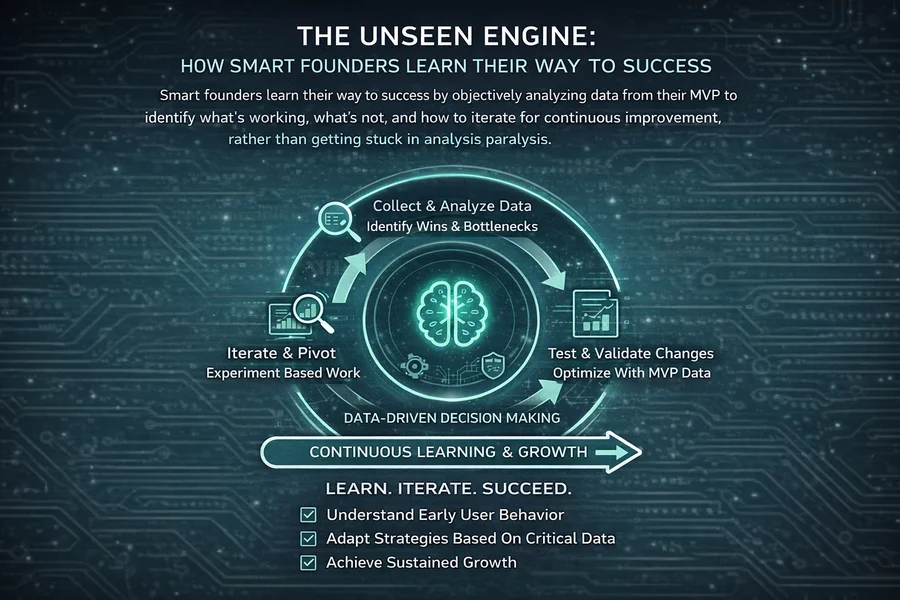
You have poured your heart and soul into an idea. You’ve sketched out the vision, built your Minimum Viable Product (MVP) in the Build phase, and gathered a mountain of data in the Measure phase. Now you stand at the most critical junction of the entrepreneurial journey: the Learn phase.
For solopreneurs and early-stage founders, this is the psychological "valley of death." It is easy to build and even easier to stare at charts, but it is incredibly difficult to look at the evidence objectively and decide that your original vision might be wrong. However, this phase is the engine that drives sustainable innovation. It is where you transform raw data into "Validated Learning."
Why "Learning" is Your Startup's Secret Weapon
In a traditional business model, success is often measured by the ability to execute a pre-defined plan. In the Lean Startup world, success is measured by the speed at which you learn what customers actually want.
The Scientific Method for Business
Learning allows you to:
- Refine your assumptions: Move from "I think people want this" to "I know 40% of users click this button."
- Optimize your offering: Identify the "Signal" (valuable features) in the "Noise" (distracting features).
- Avoid wasted effort: Stop polishing the brass on a sinking ship.
- Adapt to market changes: Stay agile when competitors emerge or technology shifts.
"The only way to win is to learn faster than anyone else." — Eric Ries
Establishing Your Feedback Superhighway
To learn, you need a direct line to your users. While the Measure phase gives you the what (the quantitative data), the Learn phase requires the why (the qualitative insight).
The "Mom Test" and Effective User Interviews
Channels for Qualitative Feedback
- Direct Conversations: Reach out to your first 10 users personally. A 15-minute Zoom call is worth more than 1,000 survey responses.
- In-App Feedback Loops: Use simple "Was this helpful?" prompts after a user completes a core task.
- Social Listening: Monitor Reddit, Twitter, and niche forums where your target audience hangs out. What are they complaining about regarding your competitors?
- Customer Support Logs: Every support ticket is a data point. If five people ask the same question, your UI is failing to teach them.
Iteration: The Art of Small, Smart Improvements
Once the feedback starts rolling in, you enter the cycle of iteration. This is not about a total overhaul; it’s about making targeted, incremental changes to see if they move your One Metric That Matters (OMTM).
The "One Thing" Rule
When you have a list of 50 possible improvements, you must prioritize. Ask yourself: "What is the single most impactful change I can make to solve the user's biggest frustration?"
Consider these iteration strategies:
- Feature Prioritization: Use the RICE score (Reach, Impact, Confidence, Effort) to rank your ideas.
- User Flow Optimization: If data shows users drop off at Step 3 of your sign-up, iterate on only that step.
- Messaging and Positioning: Sometimes the product is fine, but the way you describe it is confusing. Iterate on your landing page copy before you change a single line of code.
The Virtuous Cycle
Each iteration is a new experiment. You Build the tweak, Measure the impact on the cohort, and Learn if it worked. If the metric moves in the right direction, you've achieved validated learning.
Pivot or Persevere: The Courageous Decision
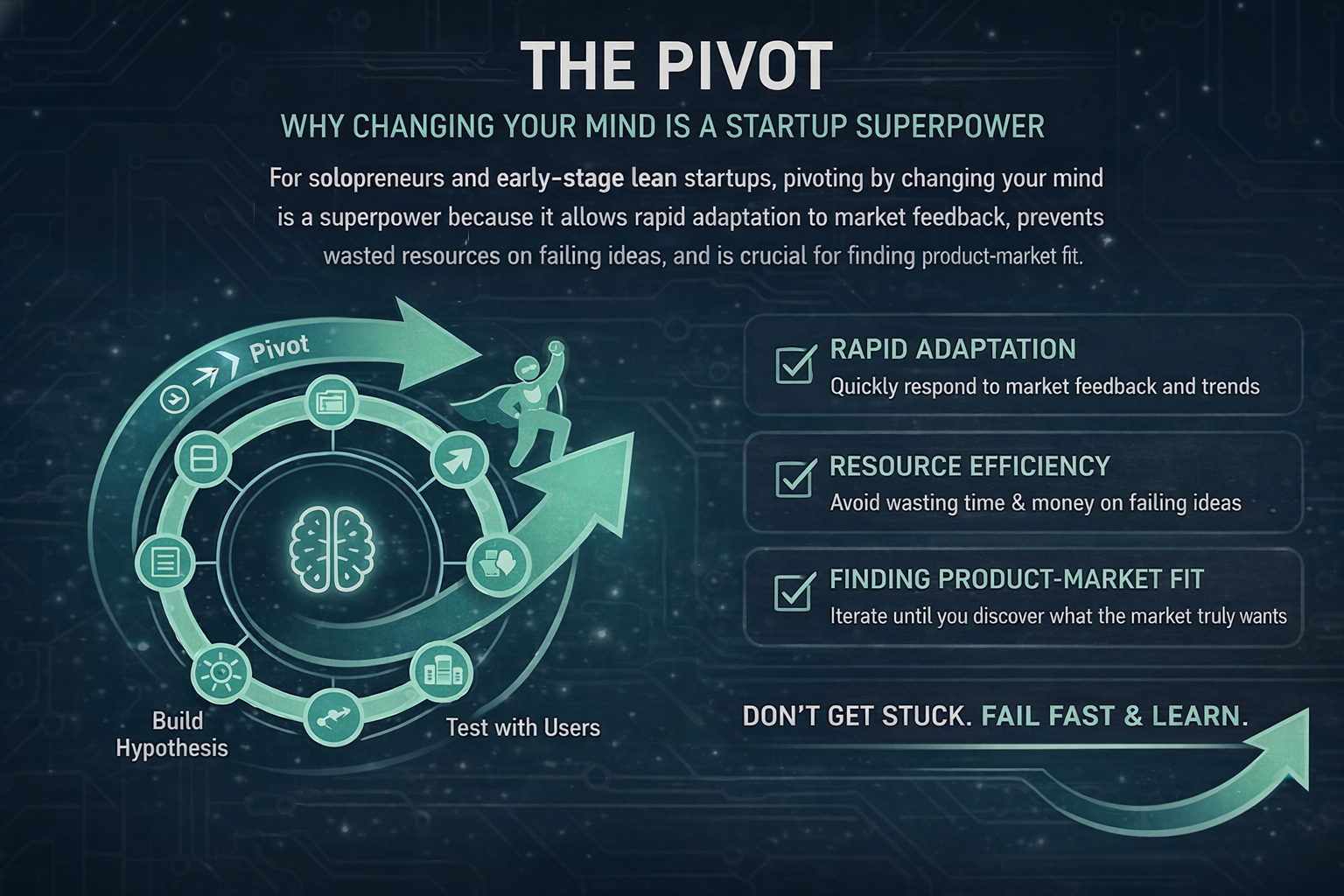
The most famous concept in the Lean Startup methodology is the Pivot. This is a structured change in strategy designed to test a new fundamental hypothesis about the product, strategy, and engine of growth.
When to Persevere
You should persevere when your metrics are moving in the right direction, even if they are moving slowly. If your retention rate is growing and your CAC is shrinking, you have found a vein of gold—you just need to keep digging.
When to Pivot
Common Types of Pivots
- Zoom-in Pivot: A single feature of your MVP becomes the entire product. (Example: Instagram started as Burbn, a complex check-in app; they realized people only liked the photo filters and "zoomed in.")
- Zoom-out Pivot: Your entire product becomes just one feature in a larger, more comprehensive solution.
- Customer Segment Pivot: You realize your product solves a problem, but for a different group of people than you expected.
- Platform Pivot: Shifting from an application to a platform (or vice versa).
- Business Architecture Pivot: Switching from high-margin/low-volume (B2B) to low-margin/high-volume (B2C).
- Channel Pivot: The product stays the same, but the way you reach customers changes (e.g., moving from Facebook ads to direct sales).
The Psychology of the Pivot: Why It’s Not Failure
The word "pivot" is often used to mask a failure, but in the Lean Startup world, a pivot is a success. It means you have successfully learned that one path is a dead end and you are now moving toward a path with more potential.
Overcoming Sunk Cost Fallacy
The "Pivot Meeting"
If you haven't hit your goals, be brutally honest. Is it a failure of execution (keep persevering) or a failure of the hypothesis (time to pivot)?
Building a Culture of Learning
Even if you are a team of one, you must foster a mindset that values truth over ego.
- Document Your Hypotheses: Before every build, write down: "I believe that by doing X, Y will happen, and we will see it in metric Z."
- Celebrate Invalidated Hypotheses: When an experiment fails, don't be discouraged. You just saved yourself months of building the wrong thing.
- Stay Close to the Customer: The moment you stop talking to users is the moment you stop learning and start guessing.
Conclusion: The Loop Never Ends
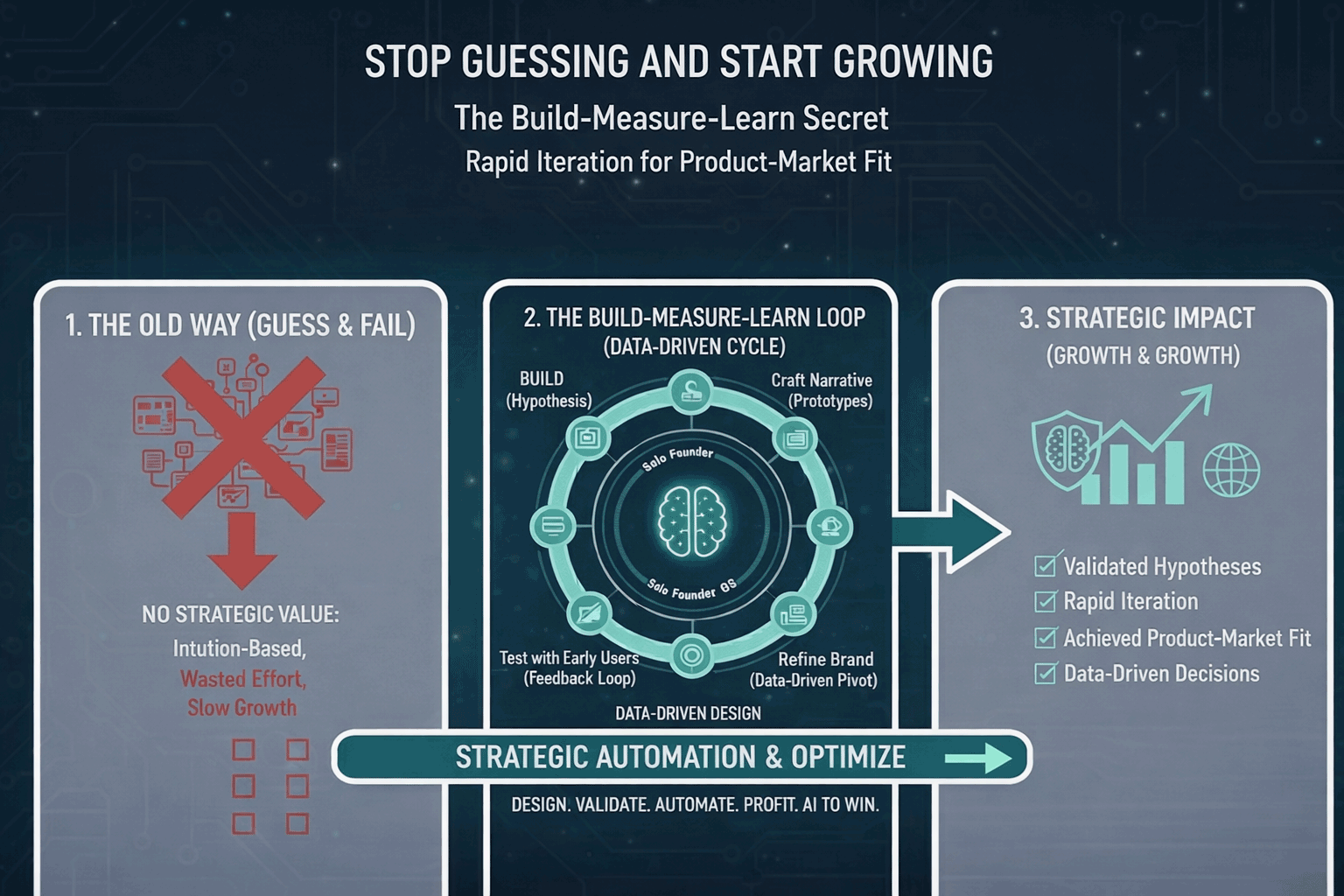
The Build-Measure-Learn cycle is not a one-time event; it is a permanent loop. Even billion-dollar companies like Amazon and Netflix are constantly running these cycles.
By embracing the Learn phase, you move beyond the "lottery ticket" mentality of entrepreneurship. You aren't just hoping to get lucky; you are systematically narrowing the gap between your vision and reality. You are building a business that is grounded in facts, responsive to users, and built to last.
Now, take the data from your latest "Measure" phase, look at it with clear eyes, and ask yourself the most important question in business: What did we learn today?
Check-List: Is Your "Learn" Phase Complete?
- Qualitative Deep Dive: Have I talked to at least 5 users in the last two weeks?
- Identify the "Why": Do I understand why the metrics moved (or didn't move) in the Measure phase?
- Hypothesis Check: Did the data validate or invalidate my initial assumptions?
- The Big Decision: Based on the evidence, have I officially decided to Persevere or Pivot?
- Next Build Cycle: Have I defined the next experiment based on these lessons?
The loop starts again. Ready to Build the next iteration?

No comments yet
Be the first to share your thoughts on this article!