In most parts of life, "changing your mind" is seen as a weakness. If you change your college major three times, people call you indecisive. If you quit a project halfway through, people call you a quitter. We are taught from a young age that success comes from "sticking to the plan" and "powering through" no matter what.
But in the world of the Build-Measure-Learn loop, sticking to a failing plan isn't brave—it’s suicide.
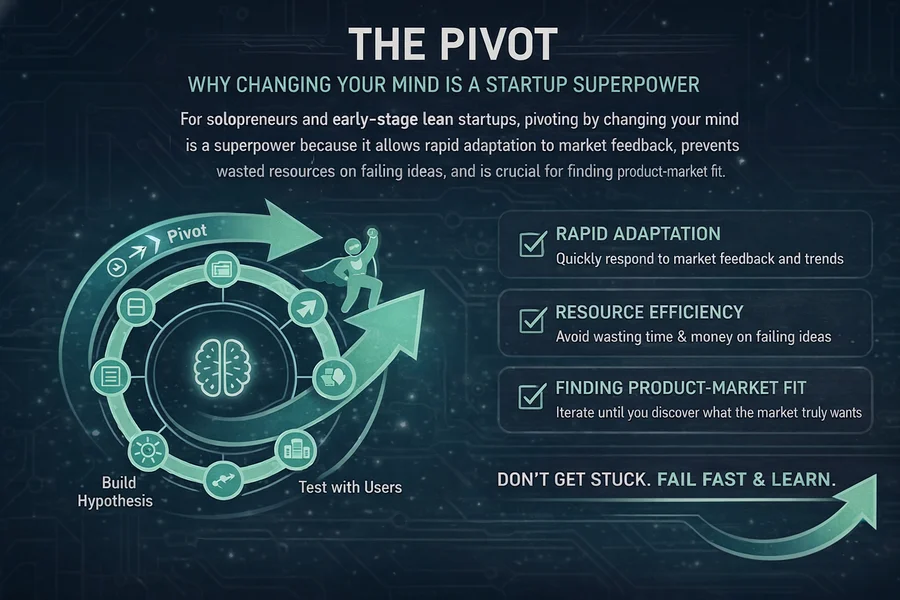
For a solopreneur or an early-stage founder, the most important skill you can develop isn't coding, marketing, or sales. It is the ability to Pivot. A pivot is a structured course correction designed to test a new fundamental hypothesis about your product, strategy, and engine of growth.
In this post, we’re going to look at why the pivot is the "moment of truth" for every founder, how to know when it’s time to turn the steering wheel, and why a pivot is actually a victory, not a failure.
What is a Pivot, Exactly?
The word "pivot" was popularized by Eric Ries, the author of The Lean Startup. Think of it like a basketball player: they keep one foot firmly planted on the ground while moving the other foot to find a better angle to pass or shoot.
In business, your "planted foot" is what you’ve learned so far—the things you know for sure about your market. Your "moving foot" is the part of your business model you are changing because the data told you the old way wasn't working.
A pivot is not the same as "quitting." When you quit, you go home. When you pivot, you take everything you learned from your first attempt and apply it to a smarter, better version of your idea.
The "Learn" Phase: The Pivot or Persevere Meeting
Every month, you should have a "Pivot or Persevere" meeting with yourself (or your co-founders). During this meeting, you look at the Actionable Metrics you gathered in the "Measure" phase and ask: “Are we making enough progress to justify our current strategy?”
If your numbers are improving—if your conversion rate is going up and people are staying longer—then you Persevere. You keep doing what you’re doing.
But if your numbers have "plateaued" (meaning they’ve stopped getting better no matter how hard you work), it’s time to consider a pivot. You have hit a wall, and no amount of "hard work" will get you through it. You need a change in direction.
💡 Key Insight: A pivot is a structured course correction designed to test a new fundamental hypothesis about your product, strategy, and engine of growth.
The 10 Types of Pivots
Pivoting doesn't always mean starting from scratch. Usually, it means changing one specific part of your business. Here are the most common types of pivots for solopreneurs:
Example: You built a massive social media platform for birdwatchers, but you notice that the only thing people use is the "photo filter" tool. You pivot to just being a photo-editing app for nature photographers.
Example: Your "invoicing app" isn't selling, so you expand it into a full "freelance management suite" that includes time tracking and contracts.
Example: You built a scheduling tool for "personal trainers," but you realize that "dentists" are the ones actually signing up and paying for it.
Example: You tried to sell "healthy snacks" to offices, but you learned they don't care about the snacks—they care about the fact that their breakroom is messy and unorganized. You pivot to a "breakroom management service."
Example: You built a successful online course. You realize other teachers want to use your software to build their courses. You pivot from being a "teacher" to being a "platform for teachers."
Example: You change from a one-time "Buy it Now" price to a monthly subscription.
The Psychological Barrier: Why Pivoting is Hard
If pivoting is so smart, why do so many founders refuse to do it? Why do people go down with the ship?
- Sunk Cost Fallacy: This is the feeling that "I’ve already spent $2,000 and 3 months on this, I can't stop now!" You feel like you’re throwing that time and money away. In reality, that money is gone regardless. The only question is: are you going to waste the next 3 months too?
- The "Visionary" Ego: Many founders believe they are like Steve Jobs. They think they know what the customer wants better than the customer does. This pride prevents them from listening to the data.
- Fear of Judgment: You told your friends, your family, and your LinkedIn followers about your "AI-powered toaster." Admitting that nobody wants an AI-powered toaster feels like admitting failure.
The most successful companies in the world are the result of pivots. Slack started as a failing video game. Instagram started as a complicated app called Burbn that did too many things. YouTube started as a dating site! If these giants weren't too proud to pivot, you shouldn't be either.
How to Pivot Without Losing Your Mind
Pivoting can be chaotic. To do it right, follow these steps:
⚠️ Important: Pivot while you still have the energy to execute.
Study: The Solopreneur Pivot
Let’s look at "Sarah," a solopreneur who wants to help people with productivity.
- Build 1: Sarah builds a 10-week intensive "Productivity Boot Camp" for $500.
- Measure 1: She gets 1,000 visitors to her site. 0 sales. She interviews a few people who clicked the link but didn't buy. They say, "I'm too busy for a 10-week course. That's why I need productivity help!"
- Learn 1: The "Need" is real, but the "Product" is too big.
- Pivot (Zoom-In): Sarah pivots. She takes the "Time-Blocking" worksheet from Week 2 of her course and sells it as a standalone $19 digital download.
- Build 2: She creates a simple PDF and a one-page checkout.
- Measure 2: She gets 100 visitors and 10 sales.
- Learn 2: She has validated that people want a quick, cheap fix, not a long course.
Sarah didn't "fail" at her boot camp. She used the boot camp as a way to Learn what people actually wanted. By pivoting, she found a business model that actually works.
💡 Key Insight: Failure is not the opposite of success; it is a part of the process. The only true failure in a startup is "failing to learn."
Conclusion: The Power of "Recalculating"
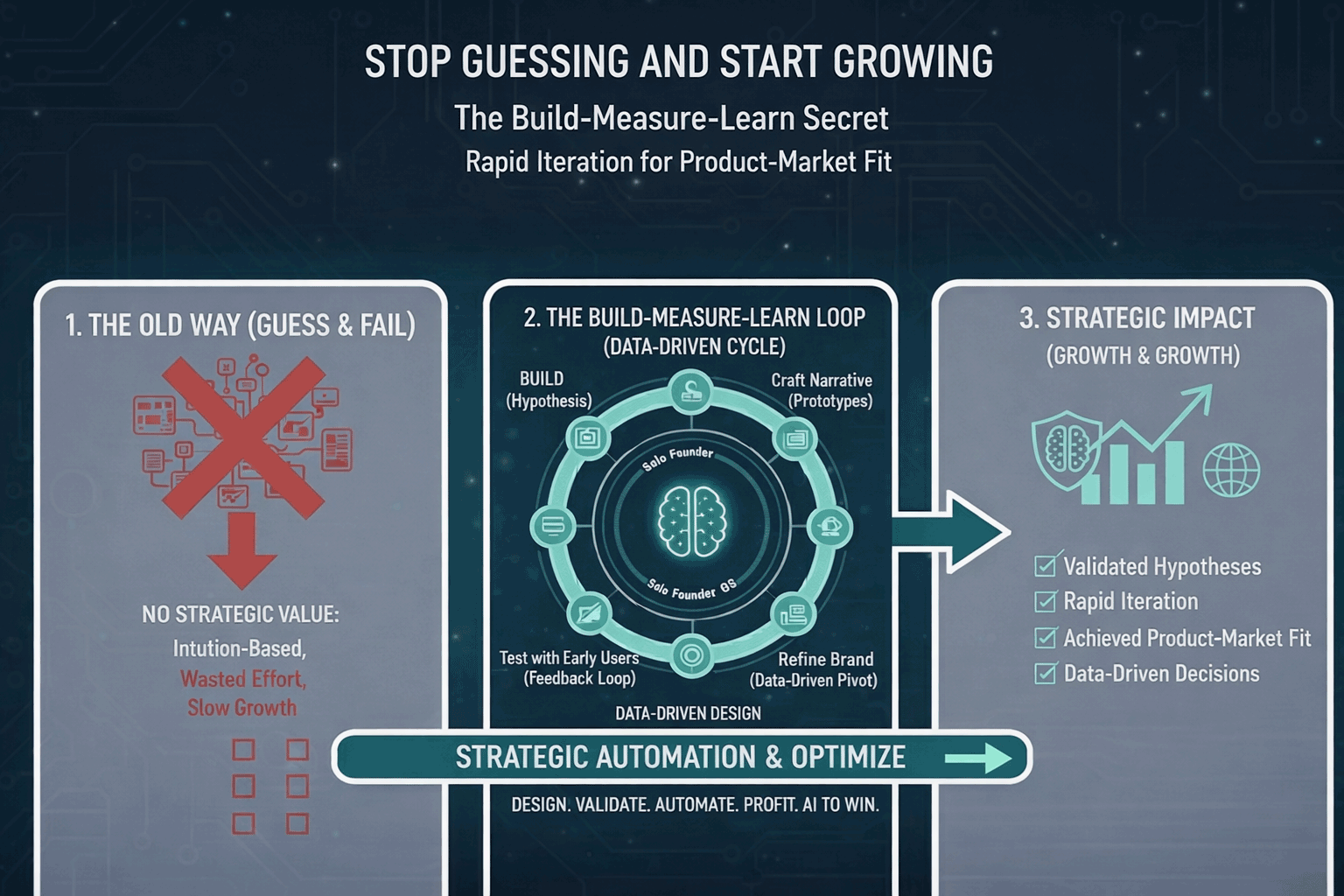
The Build-Measure-Learn loop is not a straight line; it’s a circle. You will go around it dozens, maybe hundreds of times. Each time you go through the loop, you get closer to the truth.
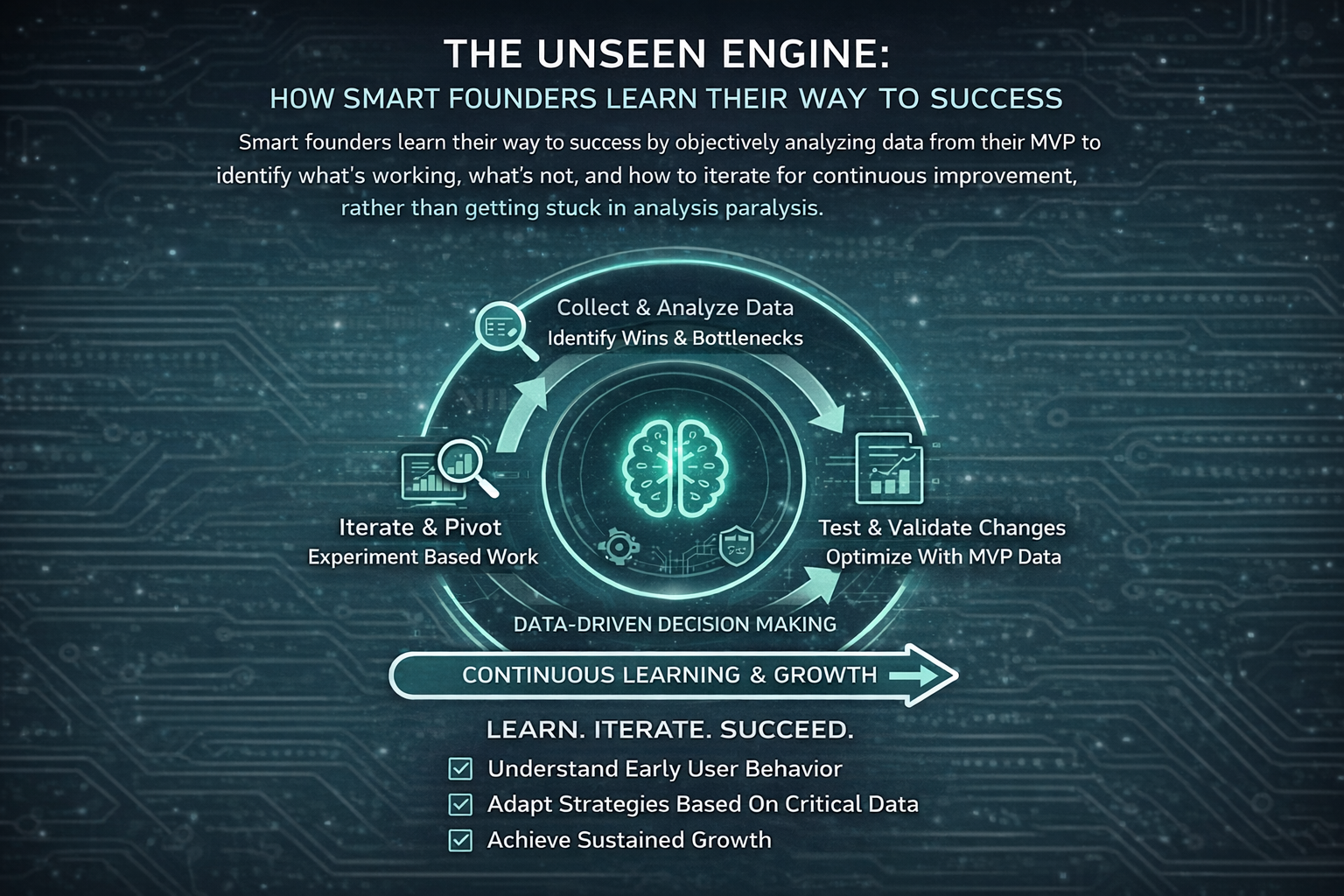
Pivoting is how you steer. Without the ability to pivot, you are just a passenger on a ship with no rudder, hoping the wind blows you in the right direction. With the ability to pivot, you are the captain. You are using the data as your map and the loop as your engine.
✅ Pro Tip: Use the data as your map and the Build-Measure-Learn loop as your engine.
Your Final Homework:
Failure is not the opposite of success; it is a part of the process. The only true failure in a startup is "failing to learn." If you learn something today that makes your business smarter tomorrow, you are winning—even if your bank account hasn't caught up yet.

No comments yet
Be the first to share your thoughts on this article!